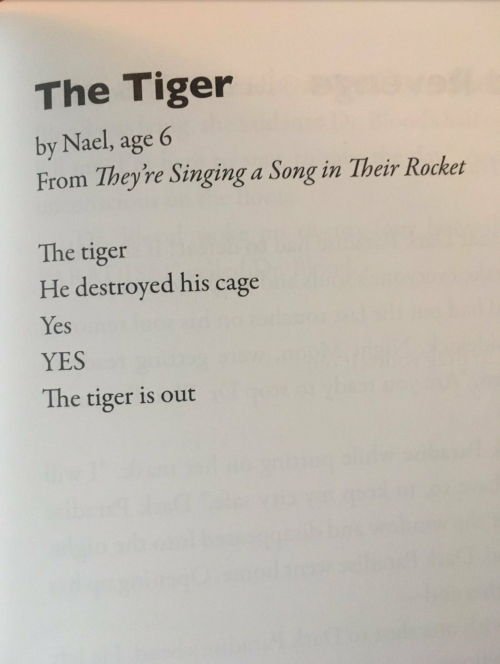
Well, I have a new favourite poet.
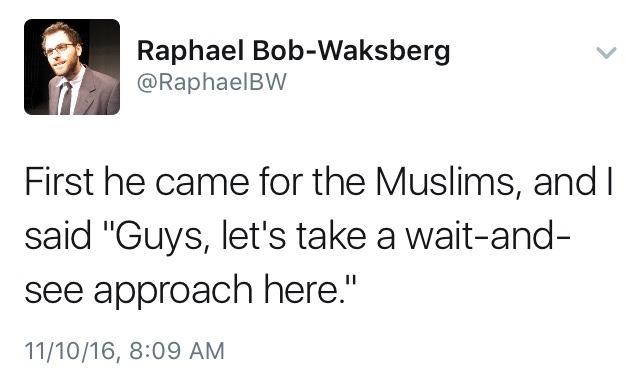
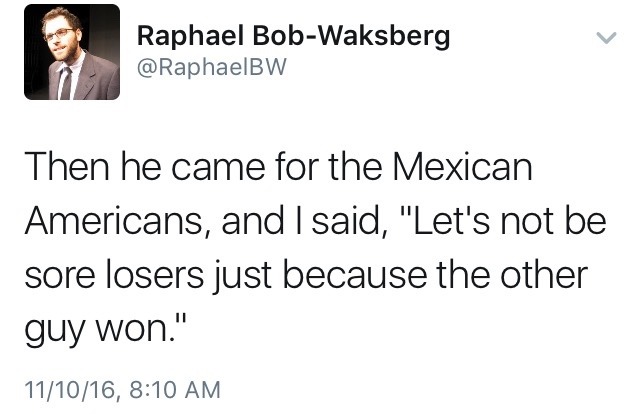
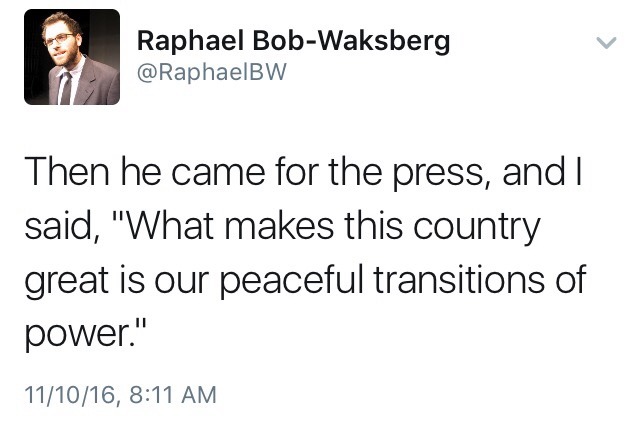
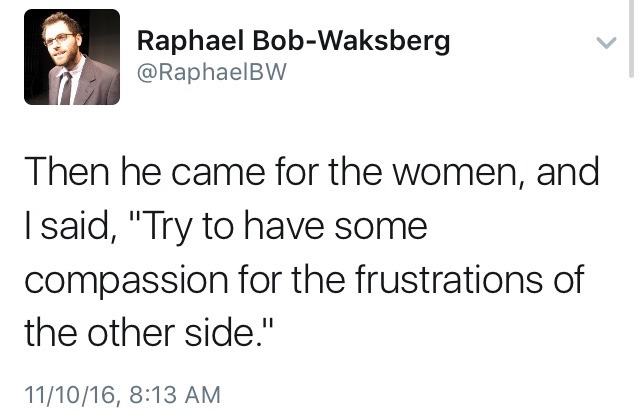
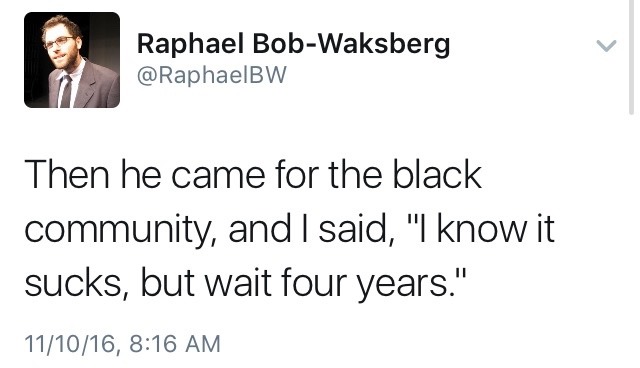
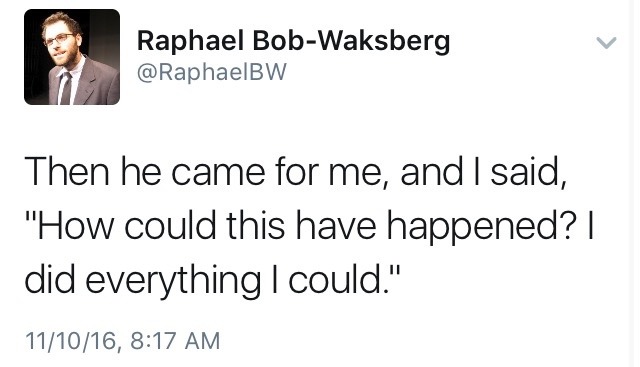
With Trump’s election and the threat of fascism, Twitter user Raphael Bob-Waksberg reminds us of Martin Niemöller’s words after WWIII:
“First they came for the Socialists, and I did not speak out—
Because I was not a Socialist.Then they came for the Trade Unionists, and I did not speak out—
Because I was not a Trade Unionist.Then they came for the Jews, and I did not speak out—
Because I was not a Jew.Then they came for me—and there was no one left to speak for me.”
I must remind myself—
they can’t tell that I didn’t write this bit immediately after that one
the six months where I ignored the manuscript are not visible to the naked eye
the bit where I put my head in my hands and muttered “I have no idea what I’m doing” takes place in the single space between the period and the next capital letter.
As soon as I shove that character in, she has always been there
and someone will probably say that she’s the emotional center
and the book couldn’t have been written without her
and nobody will know that I thought of her three thousand words from the end and scrolled up and shoehorned in a couple of paragraphs near the beginning because, for whatever reason, the story needed an elderly nun
she was almost the cook
and for about ten minutes she was the earnest young village priest
and now she has been there since you started reading.
I am sanding down the places where my editor found splinters
kicking up a fine dust of adjectives and dropped phrases
(Wear a breath mask. Work in a well-ventilated area. Have you seen what excess commas can do to your lungs?)
and eventually it will all be polished to a high shine
and hopefully when someone looks into it
they’ll see their own face reflected back
instead of mine.
Wendell Berry
1. How much poison are you willing
to eat for the success of the free
market and global trade? Please
name your preferred poisons.2. For the sake of goodness, how much
evil are you willing to do?
Fill in the following blanks
with the names of your favorite
evils and acts of hatred.3. What sacrifices are you prepared
to make for culture and civilization?
Please list the monuments, shrines,
and works of art you would
most willingly destroy.4. In the name of patriotism and
the flag, how much of our beloved
land are you willing to desecrate?
List in the following spaces
the mountains, rivers, towns, farms
you could most readily do without.5. State briefly the ideas, ideals, or hopes,
the energy sources, the kinds of security,
for which you would kill a child.
Name, please, the children whom
you would be willing to kill.
Always falling into a hole, then saying “ok, this is not your grave, get out of this hole,” getting out of the hole which is not the grave, falling into a hole again, saying “ok, this is also not your grave, get out of this hole,” getting out of that hole, falling into another one; sometimes falling into a hole within a hole, or many holes within holes, getting out of them one after the other, then falling again, saying “this is not your grave, get out of the hole”; sometimes being pushed, saying “you can not push me into this hole, it is not my grave,” and getting out defiantly, then falling into a hole again without any pushing; sometimes falling into a set of holes whose structures are predictable, ideological, and long dug, often falling into this set of structural and impersonal holes; sometimes falling into holes with other people, with other people, saying “this is not our mass grave, get out of this hole,” all together getting out of the hole together, hands and legs and arms and human ladders of each other to get out of the hole that is not the mass grave but that will only be gotten out of together; sometimes the willful-falling into a hole which is not the grave because it is easier than not falling into a hole really, but then once in it, realizing it is not the grave, getting out of the hole eventually; sometimes falling into a hole and languishing there for days, weeks, months, years, because while not the grave very difficult, still, to climb out of and you know after this hole there’s just another and another; sometimes surveying the landscape of holes and wishing for a high quality final hole; sometimes thinking of who has fallen into holes which are not graves but might be better if they were; sometimes too ardently contemplating the final hole while trying to avoid the provisional ones; sometimes dutifully falling and getting out, with perfect fortitude, saying “look at the skill and spirit with which I rise from that which resembles the grave but isn’t!“
i once saw a scientist
on television.
and she was speaking generally
about science things
(being a scientist and knowing science things
etc.)
and, speaking generally
i am not a science
person,
and while i respect them,
i do not have much interest
in scientists
or science things.
so i went to switch the channel
at the precise moment that the presenter sitting beside the scientist asked:
what,
in your opinion,
is the most ASTOUNDING fact
about the universe
?
and this stopped me.
because it is not often that television presenters ask such interesting questions,
and the scientist was pursing her lips in a thoughtful way that made me think
i wanted to her her answer
to the interesting question.
after a pause,
she did not look directly at the
camera,
but directly at the presenter.did you know,
she said,
that there are atoms in your body.
the presenter laughed.
of course,
he said.
what else would my body be made of?well,
said the scientist,
and i did not need to look at the television screen to know
she was smiling.
do you know where those atoms came from?
well,
said the presenter.
and he did not say anything else.
i snickered from my place in the armchair
and the scientist smiled again.the most ASTOUNDING fact that i have ever known,
she said,
is not a fact, specifically,
but the story of every atom on this planet.
the ones that make up the grass and the sea and the sand and the forests and the human
body.
these atoms came
from stars.the presenter sat forward and so did i.
stars,
continued the scientist,
are mortal
like humans.
they die,
and, in their later years,
are unstable.
it pains me a little to say it, but a star’s death
is far more dramatic than a human’s.
is it? asked the presenter.
the scientist was looking at him still,
and i felt strongly as though i was listening in on a very private
conversation.it is, the scientist nodded. the stars
i am referring to,
she said,
collapsed and exploded a very long time ago, and scattered their enriched guts across
the entire universe.
here, she paused, and her words caught in my mind in a way that made me wonder
if she was a scientist
or a poet.
their guts, she said whilst sipping from a glass of water, were splayed across every
inch
of time and space.
these guts were made of the
fundamental ingredients
of life and existence.
carbon and oxygen and nitrogen and hydrogen and all the
rest of it.
all in the bellies of these stars that flung themselves across the universe in protest when it was their time to die.and then? asked the presenter.
the scientist’s lips quirked upwards. and then, she said.
it all became parts of gas clouds.
ones that condense and collapse and will form our next solar systems –
billions of stars with billions of planets to orbit them.
and these planets have the ingredients of life sewed into the very fabric
of their own lives.so, she said, smile still playing on her lips –
where do your atoms come from?
from those gas clouds, said the presenter.
no, said the scientist.
from those stars.every atom, every molecule, every inhale and exhale and beat of your heart, is traceable
to the crucibles that cooked life itself.
and you are sitting here and so am i and so are your viewers at home,
and we’re all in the universe, aren’t we?
yes, said the presenter.
but i’ll tell you what’s even better, the scientist smiled wider.
the universe is in us. your atoms and my atoms and your camera men’s atoms came from those stars. you’re connected and relevant without even having to try. you are made of stardust and the fabric of the universe.
that is the most ASTOUNDING fact
i can tell you.
the presenter smiled and the scientist smiled wider and i smiled too,and later i switched the channel to something less scientific
and wondered if i should feel small,
tiny and insignificant in relation to the stars that collapsed and exploded and
threw themselves everywhere.
and that is how my mother found me,
sitting on the sofa.
and she asked me what was
wrong,
and i said,
nothing. i’m just a lot smaller than stars are.
my mother is very literal woman. as such, her natural response was:
of course you’re not. don’t you see how small stars are?
that’s only from a distance,
i said.
maybe you’re looking at yourself from a distance too, she said.and she left the room and it is years later now, but i still
think about the scientist and what she said
and my mother and what she said
and i still see the presenter on television.
and i still think that the stars are very big
but now i think,
they are in me.
so i am big too.
‘the most astounding fact’ – j.c., inspired by neil degrass tyson’s talk of the same name (via girlonfired)
@galacticsuggestions LOOK FRIEND!!!!
(via n–e-v-e-r-l-a-n-d)